
The UK’s non-surgical cosmetics industry has grown rapidly in recent years. Today, it’s thought to be worth around £3.2 billion.
Botox injections make up a sizeable chunk. However, difficulties in enforcing regulations means healthcare campaigners have long voiced concerns over the safety of carrying out Botox and other injectables.
In August 2025, following a public consultation, the UK government announced plans to introduce a licensing scheme for all non-invasive cosmetics treatments.
While nothing’s set in stone yet, the changes will likely follow in the footsteps of the Scottish government, who proposed a three-tier system for the regulation of non-surgical cosmetic procedures earlier this year.
To help you plan ahead, we’ve put together a guide to the UK’s Botox regulations. It’ll get you up to speed on everything and includes a compliance checklist to help you prepare.
We’ll keep updating it with the latest requirements so be sure to check back here as things develop...
Getting under the skin of Botox regulations in the UK
In the UK, Botox (the brand name for ‘botulinum toxin’) is a prescription-only medicine that’s perfectly legal when used in small doses for cosmetic purposes. That said, it’s not without risk, and so is regulated for safety.
It didn’t start out as a beauty fix, however. US doctors first used Botox to treat medical issues like muscle spasms, migraines, and excessive sweating. When it arrived in the UK in the late 1980s, it was mainly used for eye and muscle disorders.
By the 1990s, Botox’s reputation had shifted. Hollywood celebrities popularised it as a way to smooth out wrinkles without going under the knife. The trend quickly crossed the Atlantic, sparking a huge surge in demand.
By the early noughties, Botox wasn’t just for the rich and famous. It had become more affordable and accessible, with even high-street names like Superdrug offering walk-in appointments for anyone craving a quick, non-surgical ‘tweakment’.
Who regulates Botox in the UK?
The UK Botox market is regulated by a number of different organisations, most of which are run independently or by the government.
Each has a specific role in overseeing the drug itself, the professionals who prescribe or administer it, or the clinics where treatments take place.
Let’s break them down a bit:
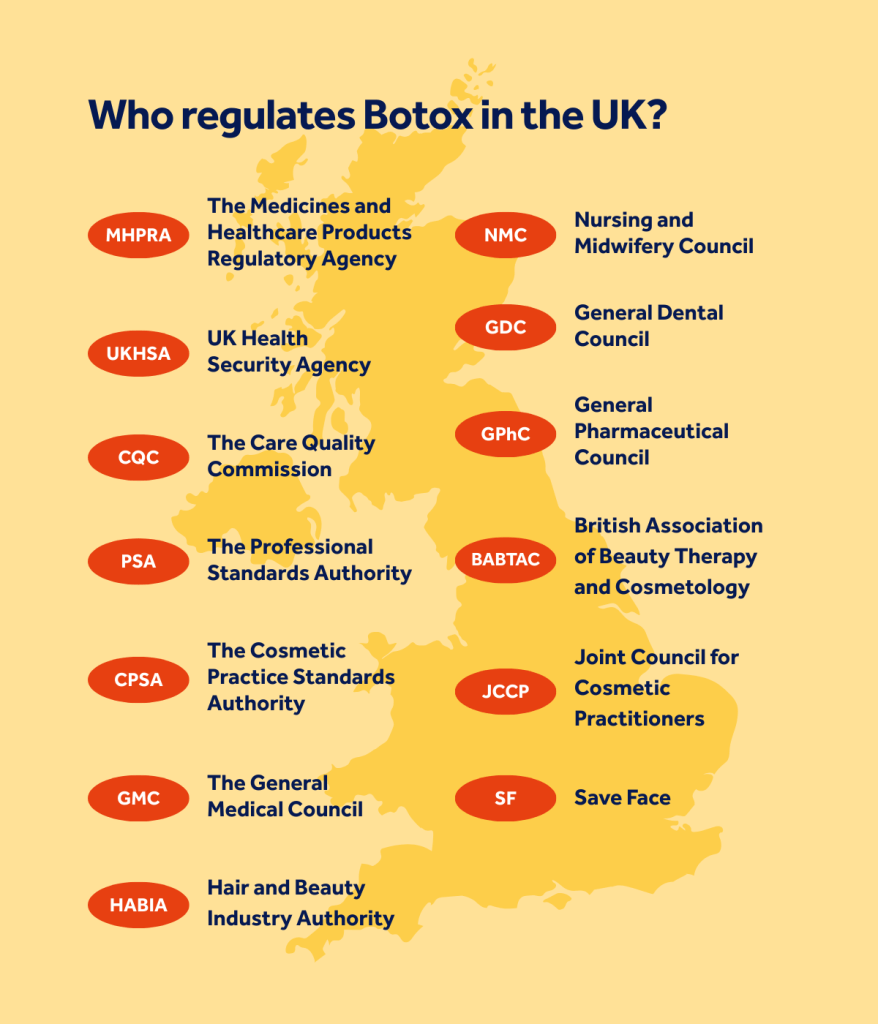
- The Medicines and Healthcare Products Regulatory Agency (MHPRA) – the government’s regulator for medicines. Responsible for the safety, licensing and manufacturing of botulinum toxin.
- UK Health Security Agency (UKHSA) – government agency carrying out research into and raising awareness of public health and safety issues.
- The Care Quality Commission (CQC) – the independent regulator for all clinics offering higher-risk treatments in the UK.
- The Professional Standards Authority (PSA) – responsible for public safety, training standards, and for improving the regulation of healthcare and social workers.
- The Cosmetic Practice Standards Authority (CPSA) – responsible for the training standards of cosmetic practitioners.
- Save Face and the Joint Council for Cosmetic Practitioners (JCCP) – both run a register for qualified practitioners. Anyone wanting to sign up with them must follow a code of practice and stick to their training standards.
- The General Medical Council (GMC), Nursing and Midwifery Council (NMC), General Dental Council (GDC), General Pharmaceutical Council (GPhC), British Association of Beauty Therapy & Cosmetology (BABTAC), Hair and Beauty Industry Authority (Habia), etc. Medical and non-medical professional bodies responsible for licensing and disciplining practitioners who prescribe and carry out Botox treatments.
What are the UK’s Botox regulations?
Botox is classed as a prescription-only medicine (POM) in the UK. Before someone can have it injected, they must first be examined in person by a registered medic (i.e. a doctor, dentist, nurse, or pharmacist prescriber).
In January 2025, the Nursing and Midwifery Council (NMC) issued new prescribing rules to its members, stating that Botox could only be prescribed following a face-to-face consultation with a prescribing nurse.
In doing so, it became the latest regulator to close the net on remote prescribing, requiring that patients are physically examined and their risks assessed before they're prescribed Botox or any other toxin.
As of 2025, however, there are still no legal requirements for the administering of Botox and other injectables...beyond certain laws affecting under-18s:
- Under the Botulinum Toxin and Cosmetic Fillers (Children) Act, it’s illegal to give Botox as a cosmetics treatment to anyone under the age of 18.
- Advertising Botox and other non-surgical cosmetic procedures to under-18s on social media, via influencers, cosmetics campaign ads or any other form of online or traditional marketing is strictly prohibited by the Advertising Standards Authority (ASA).
Why are the UK’s Botox regulations changing?
Botox’s use has been super-charged by its promotion on social media platforms. However, its rise in popularity hasn’t been without problems.
Currently, anyone is allowed to carry out Botox injections on a client they’ve sourced Botox for, regardless of whether they’re a registered medical practitioner or a beautician.
However, this system has been open to abuse, with some medical prescribers putting patients’ lives at risk by side-stepping the rules.
In recent years, organisations like Save Face have reported growing numbers of complaints about botched and even harmful treatments.
Things got worse during the COVID-19 pandemic. With clinics closed, demand for anti-wrinkle treatments surged, leading to a rise in remote prescribing and even cases of Botulism caused by 'fake Botox'.
To tackle these issues, the UK government launched a review of the aesthetics industry in 2023, calling for stricter rules on Botox and other injectables.
This followed a 2022 amendment to the Health and Care Bill by the Department of Health and Social Care (DHSC), which gave the Health Secretary the power to introduce a national licensing scheme – marking the beginnings of a major shake-up of cosmetic regulation in the UK.
Will practitioners need a license to give Botox injections?
Not yet. But a licensing scheme is on its way and will likely resemble the one proposed by the Scottish government earlier this year.
This would categorise all non-invasive cosmetic treatments as either ‘high risk’ (‘red’), ‘medium risk’ (‘amber’) and ‘low risk’ (‘green’).
This may mean Botox injections will be marked as a ‘medium risk’ treatment in the near future. Meaning only licensed and insured practitioners will be able to carry them out. And then, only under the supervision of a registered healthcare professional...
Key requirements for Botox practitioners in 2025
The introduction of a new licensing scheme will affect Botox practitioners and clinics up and down the UK. It’s important to prepare your business sooner rather than later so you’ll be in a good position to meet the new rules.
Local authorities will be responsible for issuing licenses to carry out Botox. And while we don’t yet know what their criteria will be, you’ll probably need:
- A recognised qualification in administering Botox treatments
- Appropriate premises to practice in
- Insurance for Botox and other injectables.
Need more guidance? Any of the professional bodies that we listed would be a good starting point for seeking further advice about Botox training and requirements.
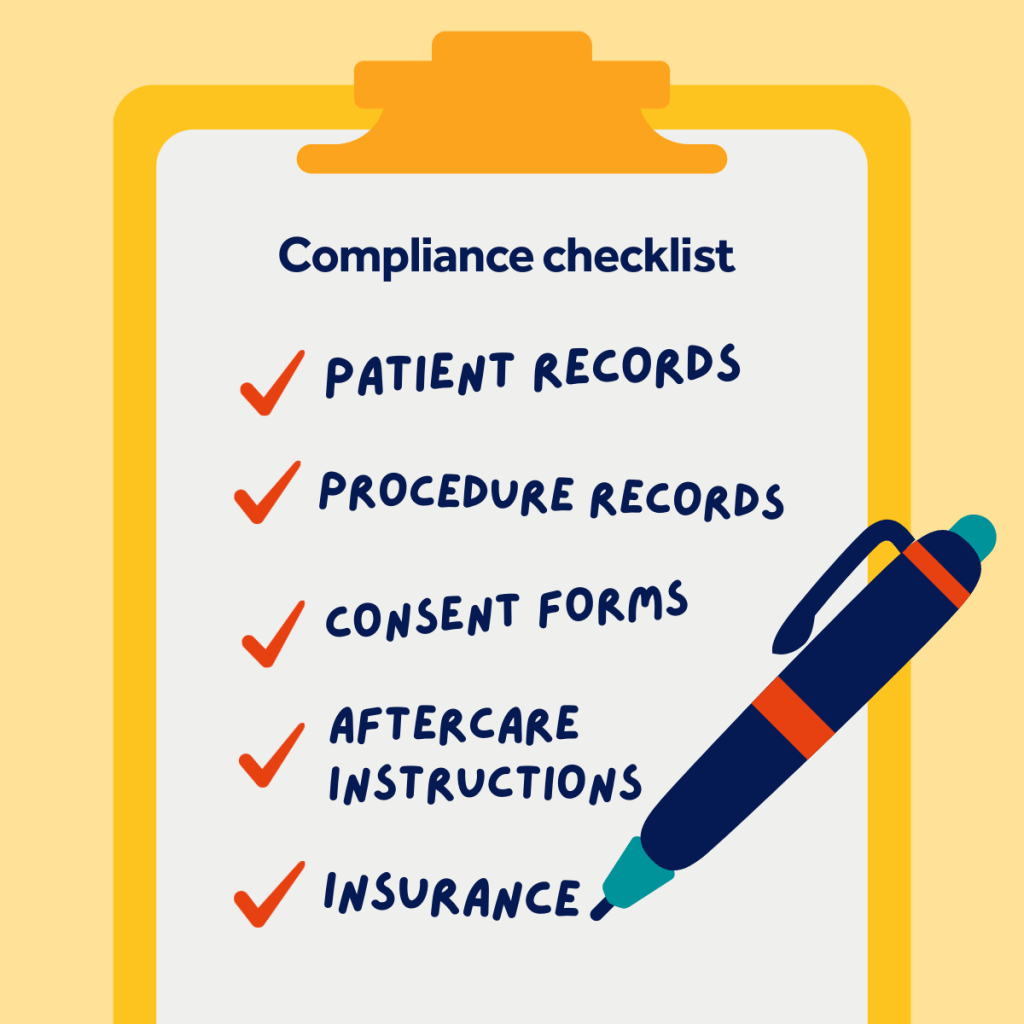
Compliance checklist for Botox practitioners
Apart from any regulatory requirements, you should always make sure you’re following best practice and putting your clients’ safety first during each and every stage of their treatment.
To make sure you protect yourself too, here’s a compliance checklist you can tick off:
- Patient records – you should know your client’s full medical history before agreeing to perform Botox on them. This means conducting a full pre-treatment consultation where you can find out about any pre-existing conditions and address their concerns.
- Procedure records – document each and every stage of the treatment, including dosage, which products you used, before and after photos, etc.
- Consent forms – these should be clearly printed and simply worded, detailing all the potential side-effects and risks involved in Botox treatment
- Aftercare instructions – making these simple and easy to follow will reduce the chances of your client developing a nasty rash or infection after treatment. Always offer a follow-up appointment where you check on their progress.
- Insurance – Medical malpractice is the most is the most important type of insurance you’ll need for Botox, covering you for mistakes made during treatment. It pays for your legal fees and any compensation you’re liable to pay in the event of a client’s injury, illness or death. You might also want employers’ liability (it’s legally required if you have employees) and public liability.
Beyond regulatory change
Preparing for regulatory change is never easy, especially when there’s uncertainty around what may be required from medical and non-medical Botox practitioners in the future.
Ultimately, though, the introduction of tighter Botox regulation in the UK will be a good thing. It’ll professionalise the industry and ensure the highest standards are maintained when it comes to the safety of clients and patients.
Protecting yourself and your clients with Botox insurance is part of that picture and is something we can help with. Call us on 0345 216 0027 for more advice.
Images ©PolicyBee 2025
aestheticsbeauty therapistsmedical malpracticenewsrules and regulationstreatment & professional liability