
Business insurance isn't exactly the bit people get excited about when they start a business.
You're busy winning clients, launching products, and hiring brilliant people. Finding the time to check you’ve got the right insurance can often fall by the wayside.
Then someone asks whether you've got employers' liability insurance (EL). Or public liability insurance (PL). Or both.
Suddenly you're drowning in acronyms and wondering if anyone actually understands what these policies do.
The good news? The difference between employers' liability and public liability insurance is surprisingly straightforward.
And once you understand who each type of insurance is designed to protect, it all starts to fall into place.
Employers' liability vs public liability insurance at a glance
Both employers' liability and public liability insurance deal with claims involving injury, illness, or damage.
The key difference is who's making the claim.
A simple way to remember it is:
If the person claiming works for you (or used to work for you), that's usually a job for employers' liability insurance.
If they're a customer, client, supplier, visitor, or member of the public, that's where public liability insurance comes in.
Think of it this way: employers' liability protects the people behind the business, while public liability protects the people who come into contact with it.
What is employers' liability insurance?
Employers' liability insurance protects your business if an employee becomes ill or injured because of their work and holds your business or organisation responsible.
Most UK businesses that employ staff are legally required to have it. That includes full-time employees, part-time employees, temporary workers, apprentices, volunteers, and, in some cases, freelancers, and contractors.
For example, imagine:
- a warehouse worker injures their back lifting stock
- a chef develops a respiratory condition after prolonged exposure to fumes
- an office employee trips over unsafe cabling and breaks their wrist.
If they're claiming the injury or illness happened because of their work, employers' liability insurance is there to back you. It’ll cover legal costs and any compensation you owe.
We have a more in-depth guide to employers’ liability if you want to find out more.
What is public liability insurance?
Public liability insurance protects your business if a third party claims you've caused injury, illness, or damage to their property.
A third party is simply anyone who doesn't work for your business. Think customers, clients, suppliers, delivery drivers, or event attendees. Or even members of the public passing by.
Common examples include:
- a customer slipping on a freshly mopped floor
- a contractor accidentally damaging a client's expensive flooring
- a visitor tripping over equipment at an event
- a falling display unit injuring someone or damaging their property.
Public liability insurance covers compensation and legal costs in these sorts of situations.
The main difference
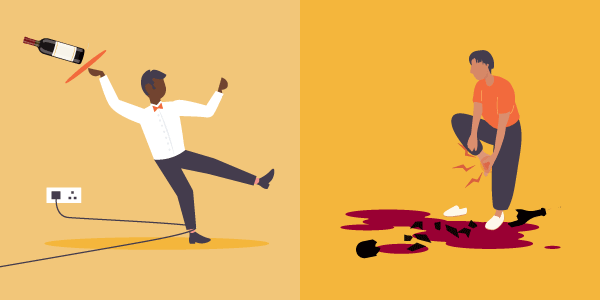
Let's say you own a café. There's a wet floor near the kitchen.
A member of staff slips while carrying a stack of plates and injures their shoulder. That falls under employers' liability insurance.
Now imagine a customer slips in exactly the same spot while heading to their table. For that, it’s public liability insurance you need.
Same floor.
Same puddle.
Same embarrassing moment for everyone involved.
Different insurance policy.
Do I need both?
Two simple questions can usually point you in the right direction:
Do you employ anyone?
Does your business interact with customers or members of the public?
You might only need employers' liability insurance if you employ people but have little or no public interaction. A software company with fully remote staff, for example, or a back-office consultancy with no customer-facing premises. Usually, these kinds of businesses don’t need public liability, but they probably do need professional indemnity insurance instead...
Professional indemnity insurance (PI) covers you for claims related to your work if you offer a service. Like not delivering what a client expected or giving someone the wrong advice.
You might only need public liability insurance if you work alone but have regular contact with the public. Think photographers, tradespeople, hairdressers and similar businesses.
If you employ people and regularly deal with customers, clients, or the public, then you’ll need both.
Is public liability insurance a legal requirement?
Unlike employers' liability insurance, public liability insurance isn't usually required by law.
But don't let that fool you into thinking it's optional in practice.
Many businesses find they can't operate without it because it's commonly required by:
- clients
- commercial landlords
- local authorities
- event venues
- professional contracts
- tender applications.
In some industries, being asked for proof of public liability insurance is almost as routine as being asked for your name. And even if you aren’t being asked for it, think about how much you interact with the public and the likelihood of something untoward happening. Accidents happen, and defending yourself could cost you more than time and money. Your reputation for one...
Can I buy employers' liability insurance and public liability insurance together?
Absolutely.
In fact, you usually have to buy them as part of the same insurance package.
You can buy public liability on its own, but usually employers’ liability can only be bought alongside public liability.
Combining your cover can make things simpler to manage and help ensure you're protected, wherever a claim comes from. Because when a claim lands on your desk, the last thing you want is to discover you've insured yourself for half the problem.
Getting the right cover isn't about ticking a box. It's about making sure one accident, injury, or claim doesn't knock your business off course.
It's much better to know the difference between EL and PL before a claim arrives than learn it the expensive way. Employers’ liability and public liability claims can end up costing you tens of thousands of pounds. Maybe more. And that’s just the financial cost...
Having the right insurance in place, and even better, using a broker, means having real peace of mind. One of the hardest things about facing a claim without support is the mental strain, and that’s no good when you’re still trying to focus on running your business.
If you need more info on public liability vs employers’ liability insurance, you can give our expert team a call on 0345 222 5391.
Image used under license from iStock.
employers liabilityemployers liability insuranceinsurance explainedpublic liability insurance