


In this guide:
- Consider alternatives to a full-time employee
- Define the employee you need
- Recruiting for success
- Interviewing effectively
- Getting ready for their first day
- Your legal responsibilities
- Employers' liability insurance
- Equipment, induction, and other final touches
- Hiring your first employee checklist
Like any of the 3.2 million sole traders in the UK, you’re probably feeling a bit snowed under. Managing your work, handling your own legal, admin, and financial obligations, not to mention needing time to actually do your job.
If you’ve landed here, you’re at the point where you’re thinking about hiring your first employee. First, congratulations! It’s a huge milestone for any business. But it does come with a lot of questions, concerns, and a few more responsibilities on your part as the business owner.
It’s a daunting prospect, we know. That’s why we’ve put together a step-by-step guide you can follow, ending in a handy checklist to make sure you have everything you need.
Taking the first step
There are loads of reasons why you might be thinking about hiring your first employee. You might have reached capacity on how many clients you can take on, your business’s growth might have plateaued, or maybe you’re just looking to gain a bit of time back for yourself.
Whatever the reason, it’s clear you need a helping hand.
Before you set your heart on a full-time employee, though, there are a few alternatives you might want to consider:
- Outsourcing – depending on what you’re looking for help with, an agency might be able to help you. If it’s support with marketing, finance, or admin, this might be a cheaper option than hiring your own employee.
- Freelancers – a freelancer is a great option if you’re looking for the support of an employee without the admin and extra responsibilities that come with it. While you won’t get full-time help, or someone who’s on-site all the time, there are freelancers who can help with almost any aspect of your business and bring a lot of valuable experience.
- Part-time – hiring a part-time employee is a great starting point, especially if you’re not sure exactly how they’ll fit into your business or how much work they’ll have.
- Fixed-term contract – got a big project coming up and need some temporary help? A fixed-term contract employee can fill a skill or capacity gap in the short-term and provide a lot of flexibility.
A full-time employee isn’t always the answer. Consider your situation carefully and weigh up your options before committing.
It can be a great idea to start with a freelancer to test the role and figure out exactly how much help you need and how they’ll fit into your business. Likewise, part-time employees are great for having extra support without the financial burden of full-time hours.
You also need to consider the financial reality of hiring your first employee. We’ll go into more detail on this later, but employees come with extra overheads including: salary, national insurance and pension contributions, extra admin, employers’ liability insurance obligations, and more.
Define the employee you need
Now you’ve decided what route to go down, it’s time to define the role of your new employee.
This starts with creating a job specification. A good job spec helps you avoid hiring the wrong person, which can lead to wasted time, money, and energy – resources you can’t afford to lose as a sole trader.
From your perspective, writing a job spec forces you to think carefully about the work you need your employee to do. As well as the job outcomes you want them to achieve and the skills they’ll need to achieve them.
Acas have written a guide, complete with templates, on creating a good job spec. If you’re short on time, here’s a summary of what you’ll need to include:
- A realistic job title – keep it simple and representative of the position. Avoid using overly complex or inflated terms.
- Purpose of the role – a short paragraph detailing the core reason the role exists and the measurable outcomes you’ll expect your new employee to achieve.
- Key responsibilities – list the tasks you expect your new employee to handle. Try and keep this around 5-10 points and concise. Make sure each one is action-based eg produce and send invoices, manage client communications etc.
- Required skills and experience – focus on the essentials. Anything else is a bonus but you don’t want to unnecessarily narrow your pool of applicants eg able to work independently, bachelor's or higher degree, experience using software etc.
- Working pattern and expectations – be as clear as you can so there aren’t any surprises for your new employee. Outline hours per week, where you expect them to work, how you measure performance etc.
- Tools/systems you use and training you’ll provide – give them an idea of how you work, what you’ll supply them, and what training you’ll offer them when they join.
- Pay and benefits – the nitty gritty for a lot of job seekers. Include a salary range, whether the role is permanent or temporary, details on probation period, the benefits you’ll offer etc.
Getting a job specification right is tough. Especially if it’s your first time hiring an employee. Our advice is to take your time with it and consider everything carefully.
Be realistic. This goes for everything you include in your job specification. Whether it’s the amount of experience you require, the salary you’re offering, or the workload you’re asking for.
Research other similar roles in your area, speak to other business owners, and be empathetic towards your future new employee.
Recruiting for success
It’s time to put that job spec into action by creating a great job advert.
First thing’s first, consider where to advertise your job. Online job boards, like Indeed and TotalJobs can be a good place to start. Depending on your presence online, LinkedIn can also be useful for recruiting.
As it’s your first hire, though, you might want to consider a more local solution. If you have some budget spare, local recruitment agencies can be a great way to find talent. You can also lean on your local network to see if anyone knows someone who might fit the bill.
It all depends on the kind of role you’re looking to fill. More specialised roles might require you to cast the net a bit wider than a part-time admin position.
You’ve already got the job spec ready to plug into your job advert. All you need to do now is double-check everything and do some polishing. This guide from The Guardian has a bunch of useful tips that can help put that final touch on your advert.
Interviewing effectively
Applicants are starting to find their way into your inbox. Now you need to decide how you’ll shortlist them. And what kind of interview process you’ll use.
Indeed have put together a helpful guide on how to shortlist candidates that you should have a read of.
Here’s a quick summary:
- Define your criteria – using your job spec, create a 4–6-point list of must-have skills or experience. Add 2-3 optional extras that might help you separate great candidates.
- Use these criteria to score candidates – use a scoring system, like 0-5, for each point when you review CVs.
- Check for evidence, not claims – keep an eye out for clear examples of work the candidate has done. These make for great talking points in interviews.
- How they communicate – is their CV clear? Concise? Accurate?
- Make your choices – try to trim down to around 3-5 candidates before you invite them for interviews. The more people you interview, the more work for you. It can also make it tougher to come to a final decision.
- Give them a call – when you’ve decided on your list, give each one a quick call. Use this to check some basics: their location, right-to-work status, availability etc. This can help you and the candidate avoid wasting time if they don’t match your requirements.
- Keep notes – document how you come to your decisions on each candidate. This lets you provide them with feedback if they’re unsuccessful and makes it easier for you to make decisions.
You should now have your candidates narrowed down and your interviews arranged.
Next, decide how you’ll interview them. This means choosing what questions you’ll ask, any skill-based assessments you’ll want them to complete, and how you’ll decide between your candidates.
Here are some useful resources to help you get started:
- Acas’s guide on how to recruit includes some great advice on interviewing, as well as how to avoid discriminatory practices in your interviewing process.
- Indeed have some actionable advice on conducting interviews, including how to structure them and make them work for you.
- You also need to think about what you’ll do post-interview. Reed has put together a guide on all things interviews, including how to liaise with candidates afterwards.
Our top tip? Communicate clearly and openly with your candidates. If they’re not successful, let them know and try to provide some feedback so they know why they missed out. Don’t leave anyone hanging. Tell them when you’ll communicate with them and stick to it.
Finally, if you opt for skill-based assessments, keep them simple and short. Nobody wants to feel taken advantage of, but they do understand the need to demonstrate their abilities.
Getting ready for the first day
You’ve written your job spec and your job advert is bringing in interviewees. Before hiring your first employee ever, make sure you’ve got your legal responsibilities in order.
Unfortunately, there’s a lot to prepare before that first day comes round. Mainly because you’re going from being a sole trader to an employer.
First, you’ll need to register as an employer with HMRC. This allows you to get your employer PAYE reference number, which you’ll need to use to pay your new employee.
Next, you need to decide how you’ll run your payroll. You can either do this yourself, using software, or outsource to an accountant.
Most first-time employers opt for doing it themselves. In this case, you’ll need something like Xero or Sage. This helps you keep accurate records and pay the correct amount of tax, national insurance, etc.
As part of paying your employee for the first time, you’ll need to get your new employee’s P45. If they don’t have one, don’t worry. Use the government’s starter checklist to set their PAYE up instead.
All this should set you up nicely for Making Tax Digital, a government scheme designed to digitise tax returns for small businesses and make paying your taxes easier and more efficient. You’ll need to make sure you do some reading around this and make sure you have everything in place before April 2026.
Don’t forget to check that your employee has the right to work in the UK before they start. You can find out everything you need to know in the government’s guide, but suffice to say, you’ll need copies of their relevant documents. This includes their passport, visa, or other documentation that proves their working status.
Legal responsibilities
Your payroll’s set up and you’ve got some of the most important admin out of the way. Unfortunately, it’s not quite over yet.
Next up is insurance. By law, you’re required to have employers’ liability insurance from the moment you hire someone. Make sure you have a minimum of £5 million cover and that you display your certificate somewhere your new employee can see it. We’ll cover this in more detail further down.
Automatic enrolment in a workplace pension is another requirement, as of 2012. This can get a bit complicated, as there are a lot of different rules and eligibility criteria. Your best bet is to have a read of The Pension Regulator’s guidance to find out what you need to do.
Health and safety is another legal requirement. In a nutshell, you have to keep your new employee safe while they’re at work. This starts with conducting a basic risk assessment. The Health and Safety Executive have a great beginner’s guide to help you get started.
Finally, make sure you have an employment contract ready for your new employee to sign on day one. This should outline their pay, hours, duties, holiday entitlement, notice periods, probation periods, and more. Take a look at the government’s guidance on employment contracts to make sure you have everything you need.
Employers' liability insurance
Continuing our focus on your new legal responsibilities, it’s time to hone in on employers’ liability (EL) insurance.
It’s a type of insurance you won’t have needed as a sole trader. But as a new employer, you’re required to have it by law.
Thankfully, it’s easy to get and relatively cheap. Especially if you're only hiring one employee. Here’s a simple breakdown of what you need when it comes to employers’ liability insurance:
- You must get EL insurance as soon as you become an employer.
- You need to have at least £5 million of cover.
- You need to get your EL insurance from an authorised insurer.
But why do you need it? Simply, it helps you to pay compensation if your employee is injured or becomes ill because of the work they do for you.
Accidents happen, and the last thing the government wants is for small businesses to close their doors because of them. That, alongside making sure employers have a safe workplace and healthy employment practices, is why they require it.
There are a couple of important exceptions. You don’t need EL if you employee a family member. You also don’t need it if you employ someone who’s based outside England, Scotland, Northern Ireland, and Wales.
This guide from the government has everything you need to know about your responsibilities when it comes to EL insurance. If you’re based in Northern Ireland, this is the EL guide you need. Have a read and make sure you follow the rules carefully. After all, you can be fined £2,500 for every day you’re not properly insured!
Final touches
Once you’ve found your employee, got all your legal responsibilities sorted, and all your systems set up, it’s time to greet your new hire.
In the lead up to their first day, make sure everything is ready for them to start their job.
If they’re an on-site employee, you'll need to:
- Get and set up any equipment they’ll need – laptop, desk, chair, monitors, peripherals, notebooks, stationery etc.
- Check your workplace has any comforts they’d expect – a fridge, a microwave, a kettle, somewhere to store their belongings etc.
- Prepare a health and safety briefing – fire exits, what to do in an emergency, locations of important safety equipment etc.
If they’re a remote employee, you’ll need to:
- Get any equipment they’ll need and guide them on how to set it up.
- Make sure their home workspace is suitable for the job you need them to do.
Whether they’re on-site or remote, prepare an induction and any initial training for them ahead of time. As a sole trader, you’ll want your new employee to be able to get started right away. The smoother the transition, the easier they’ll be able to get started.
An induction should include the following:
- Basic admin – confirm working hours and break times, run through how your payroll works, collect any extra documents you need (eg emergency contact), run through how to request holiday and report sickness.
- Tools and systems you use – give them access to their email, introduce them to any software and accounts they’ll be expected to use, show them how to access any shared file systems, help them set up their laptop/computer, explain any cybersecurity requirements etc.
- Job expectations – run through how their day-to-day will look, go through their job spec and detail how they’ll fulfil their duties, explain what good performance looks like.
- Set initial goals – some goals for their first week and first month can help to give them some direction. This could be in the form of an early task plan which includes some small, low-risk tasks that help them build up to their full role.
- Introduce key contacts – chances are you work with suppliers, contractors, and clients. Explain who’s who and set expectations as to how they should communicate with these people.
- Important policies – provide a copy of their work contract, explain any core company policies such as data handling, social media, confidentiality etc.
All of this helps them settle in and sets expectations from the outset. Encourage them to ask any questions they have and share any concerns. The more you communicate, the better the outcome you’ll have with your new employee.
Hiring your first employee checklist
Let’s finish up by going over everything we’ve covered:
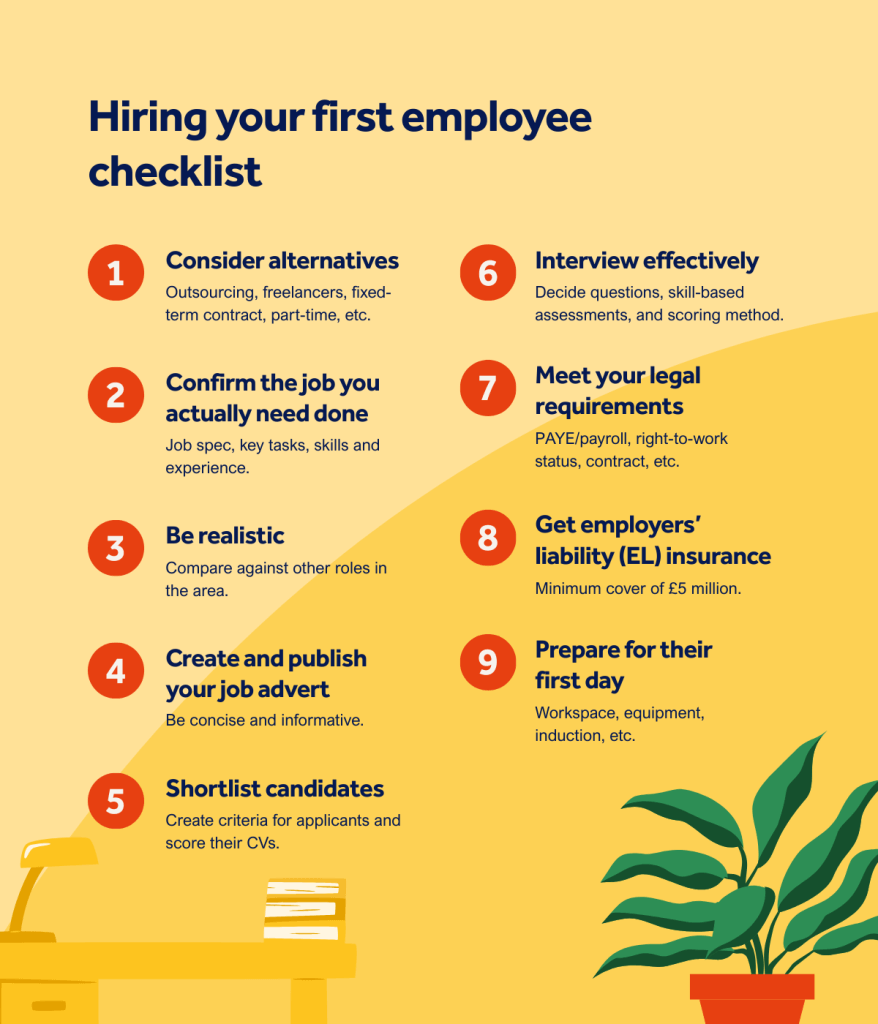
An exciting milestone
Hiring your first employee is a huge milestone for your business. It’ll help you grow and provide the support you need to succeed.
We’ve covered a lot in this guide, but that doesn’t mean you have to rush the process yourself. There’s a lot to do when hiring your first team member, so take your time and make sure you’re not overwhelming yourself.
Need any extra support with employers’ liability insurance? That’s an area of expertise for us. We’re happy to talk you through your options and answer any questions you may have. Give us a call on 0345 222 5391.
Images created using assets from iStock.
business advicebusiness guidesemployers liability insurancefreelancersrules and regulationsrunning a business